1) Establishment of 3-dimensional (3D) Culture System
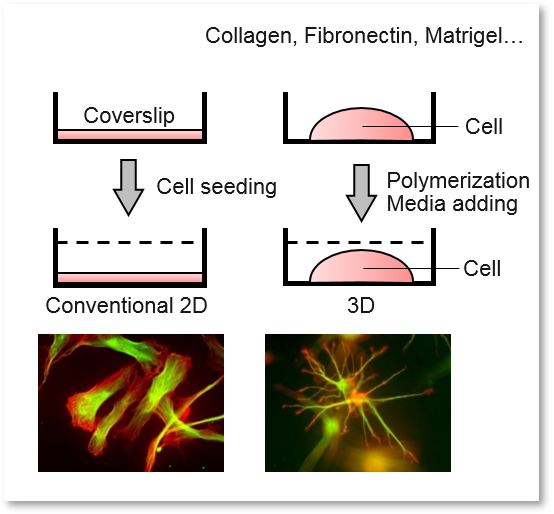
Cells are surrounded by extracellular matrix (ECM) composed with collagen, fibronectin, laminin and elastin. A diverse range of binding sites for cell-matrix interaction as well as plasticity and molecular remodeling of the matrix are critical for the organization of diverse tissues, such as skin, brain and muscle, that have specific structural and mechanical properties. The 3-dimensional (3D) matrix-cell culture system is a useful model to analyze functional and biomechanical features of cell-matrix interactions and pathogenesis, 3D model systems provide useful tools for understanding the mechanobiology of how individual cells sense and generate mechanical force in response to their surrounding environment.
2) The Study of Cell Physiology Depending on Substrate Rigidity
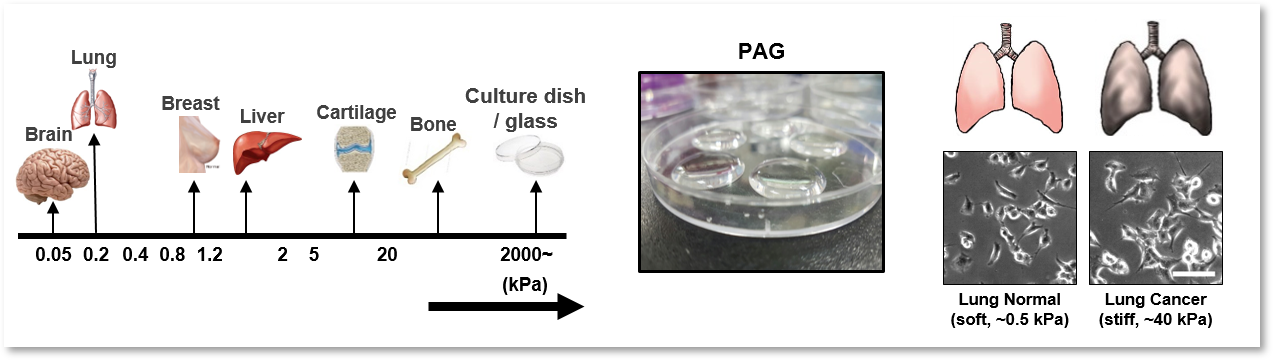
Stiffness, a biomechanical property of tissue is measured in pascals (Pa). Stiffness is diverse between organs and tissues, and is highly corresponded to tissue function. Brain and lung display relatively low stiffness, whereas bone and skeletal muscle exhibit high rigidity. The modulation of matrix elasticity with polyacrylamide gels can be a useful technique to study the relationship between cells and their biophysical microenvironment.
We can easily adjust the desired matrix stiffness by changing the relative concentrations of acrylamide, and cross-linker, bis-acrylamide.
3) Understanding Differential Signaling in 2D and 3D Environment
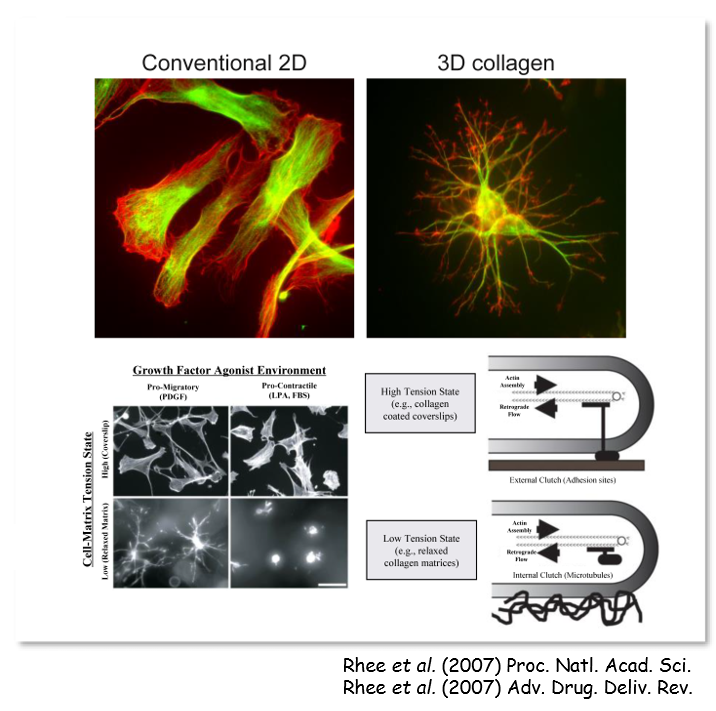
The mechanical and physical aspects of the extracellular environment significantly influence cell morphology. Fibroblasts in 2D rigid environment increase their tension with stress fibers and focal adhesion.
In contrast, fibroblasts interacting with 3D relaxed environment deplete stress fibers and the formation of focal adhesion complexes. Cells in 2D stiff environment highly respond to growth factor and accelerate the cellular signaling.
Fibroblast spreading in differential tension states is mediated by microtubule. Microtubule in 2D and 3D environment controls the balance between the polymerization and depolymerization of actin.